
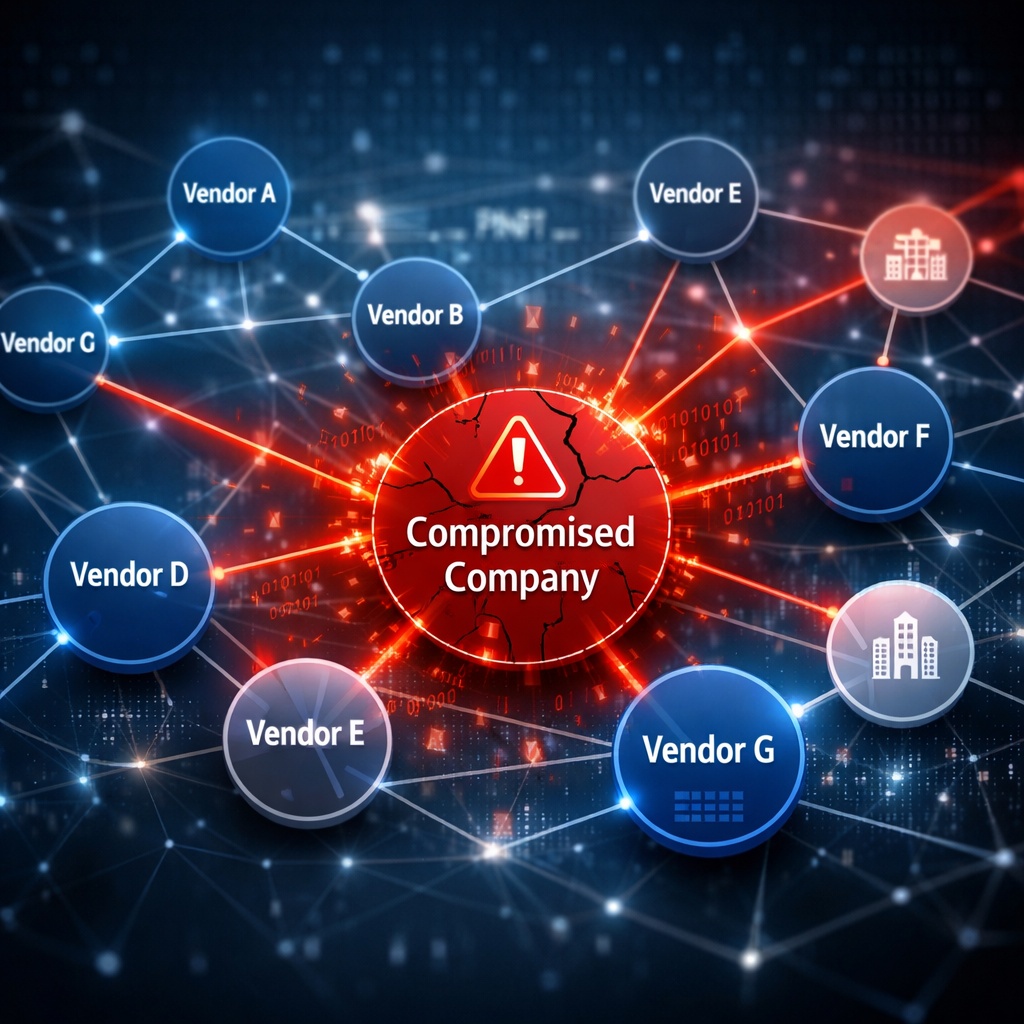
When LexisNexis confirmed a major cloud breach in March 2026 exposing legal and government client data, it exposed something every Australian business should already know: your cyber security is only as strong as the weakest vendor connected to your systems. A third-party data breach does not need to touch your infrastructure at all. It just needs to touch someone who touches you. From the OracleCMS breach that hit Victorian councils, to the Pareto Phone incident that leaked charity donor data, to MOVEit, Blackbaud, and now LexisNexis, the pattern is identical. If you are not actively managing your vendors, you are not managing your cyber risk.

Why Third-Party Data Breach Incidents Dominate the Headlines
The Office of the Australian Information Commissioner has repeatedly flagged third-party and supply-chain incidents as one of the fastest-growing breach categories. In the first half of 2025 alone, more than 30% of notifiable breaches in Australia involved a vendor, service provider, or contractor.
Recent high-profile Australian examples include:
- LexisNexis (2026) — legal and government client data exposed
- Booking.com (2026) — third-party compromise enabled targeted phishing
- OracleCMS (2024) — after-hours call centre breach impacting multiple councils
- ZircoDATA (2024) — document storage breach affecting Monash Health
- Finsure (2024) — nearly 300,000 customer emails leaked via a data partner
What Exactly Is a Third-Party Data Breach?
A third-party data breach occurs when an organisation suffers loss, exposure, or compromise of data through a vendor, supplier, contractor, SaaS provider, or any other external party with access to the organisation’s systems or information.
This includes:
- Cloud software providers storing customer data
- Outsourced IT or help-desk services
- Marketing agencies with email-list access
- Accounting firms with financial data access
- Document-storage and records-management vendors
The Five Vendor Questions Every Australian SMB Must Ask
Before you sign any contract that involves a vendor touching your data, your staff, or your systems, you need clear answers to these five questions:
- Where is our data stored and who has access? Ask for specifics, not marketing language.
- Are you aligned to Essential Eight, ISO 27001, or SOC 2? If the answer is a blank stare, reconsider.
- What is your incident response process and how quickly will we be notified? Under the Privacy Act, you may only have days.
- Do you carry cyber insurance and what are the limits? You do not want to discover this after an incident.
- Will you allow an annual security review or audit? Good vendors welcome this. Bad vendors refuse.
Recommended Link: SOC 2 Compliance Services for Australian Businesses
Contract Clauses That Actually Protect You
Most Australian SMB contracts with vendors contain generic boilerplate security language that does not survive a real breach. Stronger clauses include:
- Mandatory breach notification within 24 or 48 hours
- Rights to audit and test security controls
- Named sub-processors list and notification before changes
- Data return or destruction obligations on termination
- Liability caps that genuinely reflect breach risk
Recommended Link: Business Cyber Security Policies and Contract Review
Do You Know Which Vendor Will Cause Your Next Breach?
Third-party data breach incidents now account for a growing share of Australian notifications. You cannot delegate your risk.
- Build a prioritised vendor risk register
- Review existing contracts for breach notification clauses
Frequently Asked Questions
Q: Am I legally responsible if a vendor causes a third-party data breach?
A: In most cases, yes. Under the Privacy Act, the organisation that collected the personal information usually remains accountable, even if the breach occurred at a processor or vendor.
Q: How often should I review my vendors?
A: At minimum annually. For vendors handling sensitive data or with privileged access, a six-month review cycle is strongly recommended.
Q: What is the first vendor I should review?
A: Any vendor with access to your email environment, your customer database, your payroll system, or your financial records. These are your crown jewels.
The LexisNexis breach, the OracleCMS incident, and every other third-party data breach on the Australian record share one common feature: the victim organisations trusted their vendors without verification. Trust is not a control. Verification is.
(We are not looking to replace your current provider, just offering an alternative perspective)
Written by Neil Frick