
In March 2025, cybersecurity researchers found an unprotected ClickHouse database belonging to Sydney Tools sitting openly on the internet. No firewall. No authentication. Just 34 million customer order records and more than 5,000 employee records, including salaries and sales targets, accessible to anyone who typed the right URL. No hacker was needed. No malware. No ransomware. Just a cloud misconfiguration breach that exposed more data than most successful ransomware attacks. And Sydney Tools is nowhere near alone. Vroom by YouX, youX (twice), and countless others have all suffered cloud misconfiguration breach incidents in the last 18 months. If your business uses AWS, Azure, Google Cloud, or any SaaS platform, you are one setting away from being the next headline.

What Is a Cloud Misconfiguration Breach?
A cloud misconfiguration breach occurs when cloud infrastructure, storage, or applications are deployed with insecure default settings or administrative errors that expose data or systems without requiring any active hacking.
Common examples include:
- Publicly accessible S3 buckets or Azure Blob containers
- Databases (MongoDB, ClickHouse, Elasticsearch) exposed without authentication
- APIs without proper access controls
- Overly permissive IAM roles
- Development or test environments left on the internet
- Secrets and API keys committed to public repositories
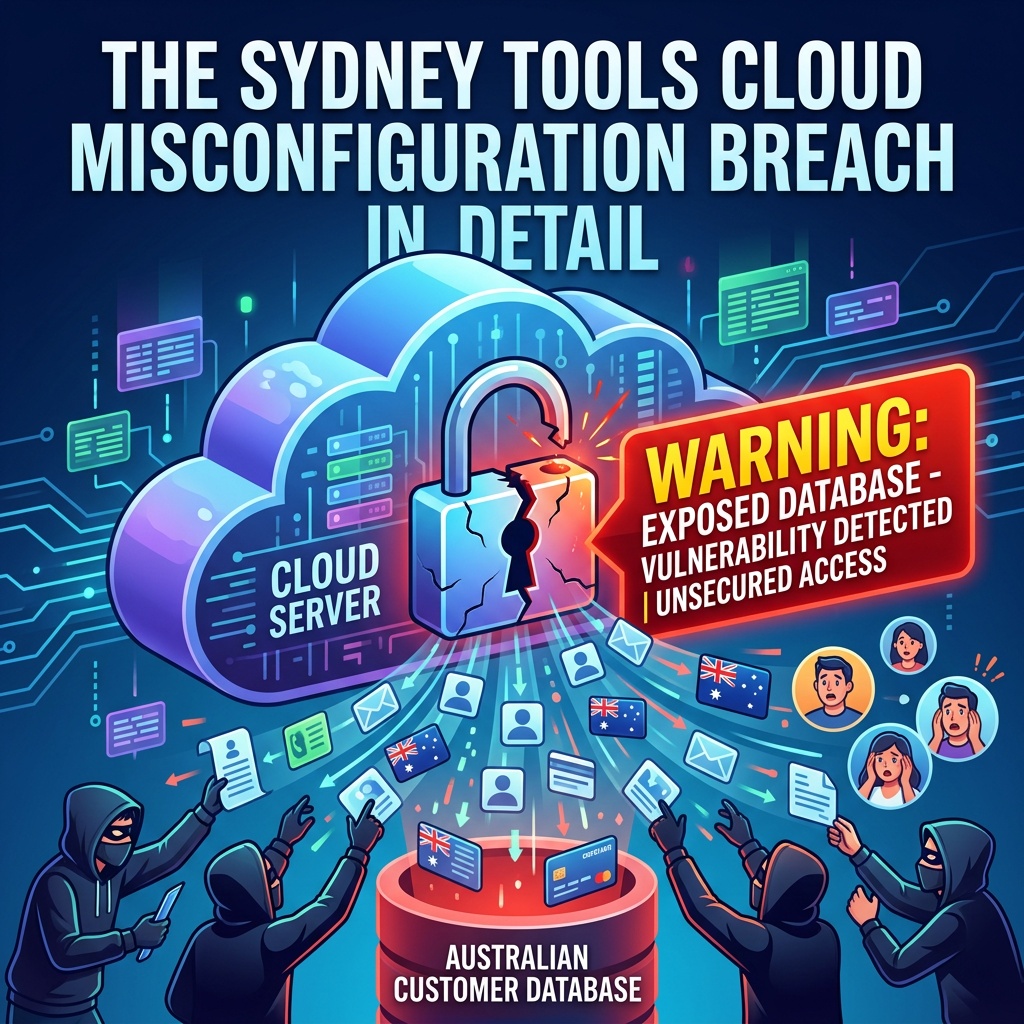
The Sydney Tools Cloud Misconfiguration Breach in Detail
Sydney Tools exposed:
- 34 million online customer order records
- Customer full names, emails, phone numbers, and home addresses
- Itemised purchase details
- 5,000+ employee records including salaries and sales targets
- Designated branch assignments
The breach was discovered by security researchers, not attackers, but once the URL was public, anyone could access the data. There is no way to know who else found it first.
The Four Cloud Misconfiguration Breach Patterns We See Most
- Default deny forgotten. Cloud services often default to private but get changed to public during testing and never changed back.
- Developer shortcuts. APIs and databases get deployed quickly without proper authentication “just for now.”
- Orphaned resources. Old projects, decommissioned apps, and test environments remain live and exposed.
- Mis-scoped IAM roles. Permissions granted too broadly that never get reviewed.
Why Your Current IT Provider May Not Be Catching These
Cloud misconfiguration breach incidents often go undetected because:
- Traditional perimeter tools do not see cloud services
- SaaS platforms operate outside traditional IT management
- Shadow IT means business units deploy cloud services without IT knowledge
- Standard vulnerability scanners do not catch configuration errors
- There is no “update available” notification for a misconfiguration
Recommended Link: Cloud Computing Services with Security First
Seven Actions to Prevent a Cloud Misconfiguration Breach
- Deploy a Cloud Security Posture Management (CSPM) tool to continuously scan for misconfigurations
- Enforce Infrastructure as Code so deployments are reviewed and version-controlled
- Implement secrets management using tools like AWS Secrets Manager or Azure Key Vault
- Run regular external attack surface reviews to find exposed services
- Audit IAM roles quarterly and remove unused permissions
- Enable cloud-native logging and monitor for configuration changes
- Train developers and admins on secure cloud deployment patterns
Recommended Link: Vulnerability Management and Continuous Assessment
Is Your Cloud Configured for Convenience or for Security?
Cloud misconfiguration breach incidents are now the most common cause of mass data exposure in Australia. A single setting can end your business.
- Book a free cloud configuration review
- Deploy continuous cloud posture monitoring
Frequently Asked Questions
Q: Isn’t cloud security the provider’s responsibility?
A: Only partially. AWS, Azure, and Google Cloud operate a shared responsibility model. They secure the infrastructure; you secure your configurations, access controls, and data. Most breaches happen on the customer side of the shared responsibility line.
Q: Does this affect us if we only use SaaS like Microsoft 365 or Xero?
A: Yes. SaaS platforms still require correct permission management, MFA, and data handling. SaaS misconfigurations are behind many Australian breaches.
Q: How often should cloud configurations be reviewed?
A: Continuously, ideally with automated tooling. Quarterly manual reviews are the bare minimum.
The Sydney Tools cloud misconfiguration breach was not a hack. It was a gift-wrapped database delivered to anyone who asked. The tragedy is that it took ten minutes to prevent and absolutely nobody inside the business noticed for an unknown period of time. Every Australian SMB using cloud services needs to ask one simple question today: who actually checks our configurations, and how often?
(We are not looking to replace your current provider, just offering an alternative perspective)
Written by Neil Frick
Sources & References
- Cyber Daily – Sydney Tools exposes 34m customer records – https://www.cyberdaily.au/security/11902-sydney-tools-exposes-34m-customer-records-after-leaving-database-unprotected
- Website Planet – Vroom by YouX report – https://www.websiteplanet.com/news/vroom-report-breach/
- OAIC Notifiable Data Breaches Report 2025 – https://www.oaic.gov.au/privacy/notifiable-data-breaches