
When a cyber attack on Victorian poultry processor Hazeldenes triggered chicken shortages in February 2026, it crossed a line Australian manufacturing had not seen before. This was not just data theft. This was operational technology being weaponised to hit shelves and supply chains. Combined with the Metricon Homes ransomware attack in July 2025, the Pressure Dynamics breach exposing 100GB of hydraulics data, the Natures Organics Medusa attack, and the Panasonic Australia incident, the manufacturing cyber attack pattern is clear: factories, builders, and food producers are now squarely in the crosshairs. If your business runs plant, production lines, or operational technology, the risk is no longer theoretical.

Why Manufacturing Cyber Attack Incidents Hit Differently
When a law firm gets ransomware, the damage is data and reputation. When a manufacturer gets ransomware, the damage is every unit not shipped, every contract at risk, every customer switching supplier. A manufacturing cyber attack impacts:
- Production line availability
- Order management and dispatch
- Inventory and raw material tracking
- Customer supply commitments
- Revenue recognition and cash flow
Metricon Homes, Australia’s largest home builder, saw 128GB of financial documents, architectural plans, and employee details stolen by the Qilin ransomware group in July 2025. The downtime alone cost hundreds of thousands of dollars.
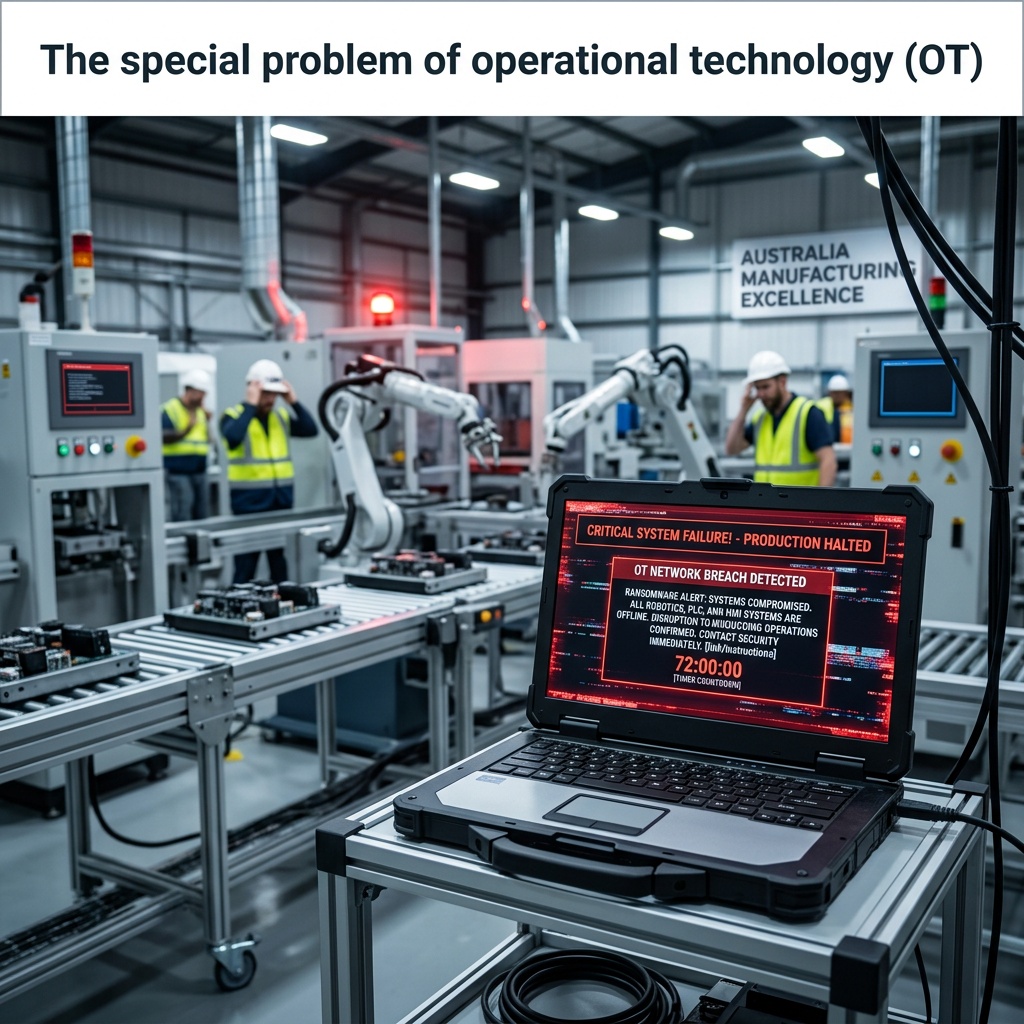
The Special Problem of Operational Technology (OT)
Australian manufacturers increasingly run operational technology (OT) networks connected to corporate IT. OT includes:
- Programmable logic controllers (PLCs) running production machinery
- SCADA systems managing plant operations
- IoT sensors tracking production, inventory, and environmental conditions
- Building management systems
These systems were designed for reliability, not security. Many cannot be patched without stopping production. Many still run Windows XP or Windows 7. Attackers know this.
The Six Most Common Entry Points for Manufacturing Cyber Attack Incidents
- Flat networks where office PCs and production equipment share the same LAN
- Remote maintenance access left permanently open for equipment vendors
- Unpatched legacy systems that nobody dares to touch
- USB drives and removable media carried between systems by engineers
- Shared credentials across multiple machines and sites
- Email phishing that reaches office staff with access to OT systems
Recommended Link: Managed IT Services for Australian Manufacturers
Five Steps to Harden a Manufacturing Environment
- Segment IT and OT networks with firewalls and strict access rules
- Inventory every connected device including legacy PLCs and sensors
- Implement secure remote access for vendors using jump hosts and time-limited credentials
- Deploy monitoring across both IT and OT environments
- Test incident response with scenarios that include plant downtime, not just data theft
Recommended Link: Business Continuity Planning for Australian Manufacturers
Could Your Factory Run Tomorrow If You Were Hit Today?
The manufacturing cyber attack surface is growing fast. Attackers have figured out that production downtime forces faster payments than data leaks.
- Audit your IT/OT segmentation
- Review vendor remote-access processes today
Frequently Asked Questions
Q: Our PLCs are 15 years old and cannot be patched. What can we do?
A: Network segmentation is your answer. If the legacy equipment cannot be patched, it must be isolated from anything that could reach the internet or a compromised workstation.
Q: Is cyber insurance enough to cover a manufacturing cyber attack?
A: Insurance can help with financial recovery, but it cannot bring your production line back online. Technical controls always come first. Insurance is a backstop, not a plan.
Q: How long does it typically take to recover from a manufacturing ransomware attack?
A: For Australian SMB manufacturers, average downtime was 24 days in 2025. This assumes tested offline backups. Without them, recovery can take months or may require partial rebuilds.
The Hazeldenes chicken shortage, the Metricon Homes data leak, and the Natures Organics breach are not isolated incidents. They are the leading edge of a manufacturing cyber attack wave that will intensify through 2026. Australian makers have a choice: get ahead of it now, or explain to customers why their order will be late.
(We are not looking to replace your current provider, just offering an alternative perspective)
Written by Neil Frick
Sources & References
- Cyber Daily – Aussie poultry processor confirms cyber attack, chicken shortages – https://www.cyberdaily.au/security/13252-fowl-play-aussie-poultry-processor-confirms-cyber-attack-chicken-shortages-hit-customers
- Cyber Daily – Australia’s largest home builder confirms ransomware attack – https://www.cyberdaily.au/security/12432-exclusive-australia-s-largest-home-builder-confirms-ransomware-attack
- ASD Essential Eight for Industrial Environments – https://www.cyber.gov.au/business-government/secure-design/operational-technology-environments