
If you’ve heard the term **ACSC Essential Eight** and nodded politely without being entirely sure what it means, you’re not alone. Most Australian business owners know they’re supposed to take cybersecurity seriously – but translating frameworks written by government agencies into practical action is another matter entirely. This guide cuts through the complexity and explains exactly what the Essential Eight is, why it matters for your business, and how to start working toward it in a way that’s manageable, not overwhelming.
What Is the ACSC Essential Eight?
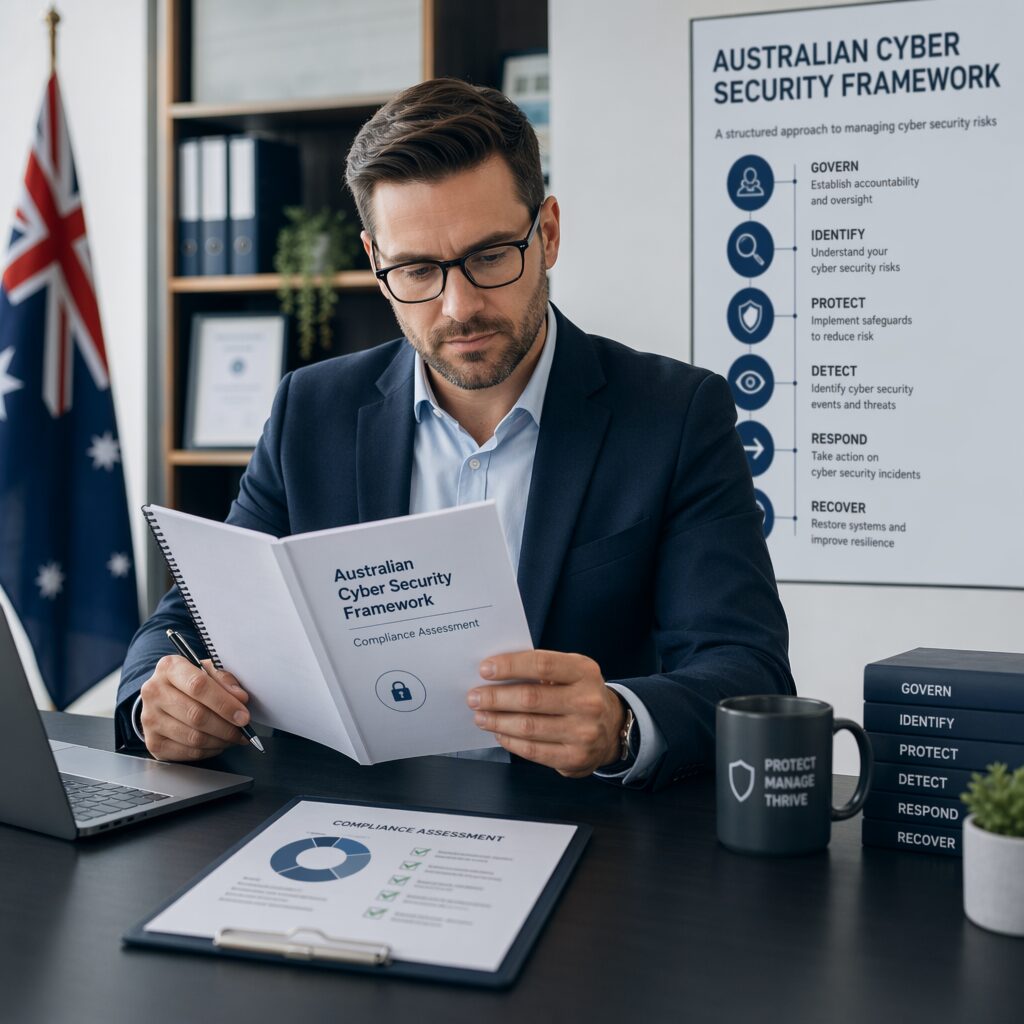
The **ACSC Essential Eight** is a set of eight baseline cybersecurity mitigation strategies developed by the Australian Cyber Security Centre (ACSC). Originally designed for federal government agencies, it has become the de facto standard for cybersecurity baseline expectations across Australian businesses – particularly in regulated industries and increasingly as a requirement for cyber insurance coverage.
The Essential Eight is not a checkbox compliance exercise. It is a prioritised, evidence-based set of controls that address the most common ways attackers compromise Australian systems. If your business implements all eight strategies to an appropriate maturity level, you eliminate the vast majority of real-world cyber threats.
The Eight Strategies, Explained Simply
1. Application Control
Only allow approved, authorised software to run on your devices. This prevents malware, ransomware, and unauthorised tools from executing – even if they somehow reach a device. Tools like **ThreatLocker** make this achievable for SMBs without enterprise IT teams.
2. Patch Applications
Keep all business applications updated promptly. Unpatched software is one of the most common entry points for attackers. Aim for patches within 48 hours for internet-facing applications with known vulnerabilities.
3. Configure Microsoft Office Macro Settings
Macros in Microsoft Office documents are a common malware delivery mechanism. Only allow macros from trusted, digitally signed sources. Most businesses have no legitimate need for unsigned macros.
4. User Application Hardening
Configure web browsers and other user-facing applications to block web-based attacks. This includes disabling Flash (already done), Java in browsers, and web advertisements from untrusted sources. DNS filtering supports this layer significantly.
5. Restrict Administrative Privileges
Admin accounts should be used only for administrative tasks – not for email, web browsing, or general work. This limits the damage an attacker can cause if they compromise a standard user account.
6. Patch Operating Systems
Like patching applications, operating systems must be kept current. Unsupported operating systems (like Windows 7 or Windows Server 2012) represent unacceptable risk and should be replaced.
7. Multi-Factor Authentication (MFA)
MFA is required for all users, particularly for remote access, privileged accounts, and cloud services. Microsoft’s own data shows MFA blocks over 99.9% of automated credential attacks. This is the single highest-impact control available.
8. Regular Backups
Backups of important data should be automated, encrypted, stored offsite, and tested regularly. The backup must be isolated from the primary network to prevent ransomware from encrypting it.
The Maturity Levels: Where Does Your Business Sit?
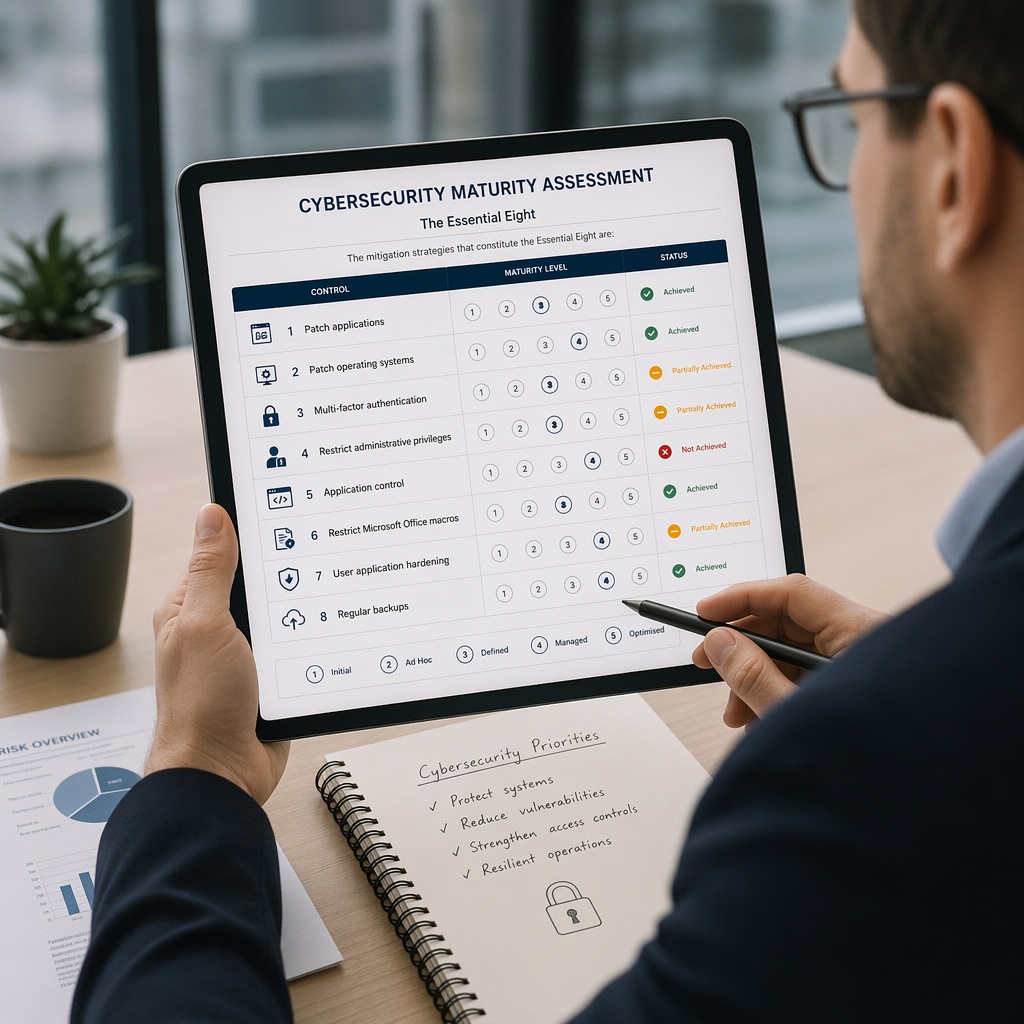
The Essential Eight uses a **maturity model** with four levels:
**Maturity Level Zero:** Weaknesses exist that increase the likelihood of compromise. Foundational controls are absent.
**Maturity Level One:** The business is partially protected against opportunistic, low-sophistication attacks
**Maturity Level Two:** The business is partially protected against more targeted, moderately sophisticated attackers
**Maturity Level Three:** The business is well-protected against sophisticated, targeted adversaries
For most Australian SMBs, the realistic and valuable target is **Maturity Level Two**. This level eliminates the vast majority of real-world threats without requiring the resources of a large enterprise.
Why the Essential Eight Matters for Your Business Right Now
The **ACSC Essential Eight** is increasingly referenced in contexts that directly affect SMBs:
**Cyber Insurance**
Insurers are increasingly requiring Essential Eight alignment as a condition of coverage – and using it to assess premiums and claim eligibility. A business that cannot demonstrate Essential Eight controls may find their claim reduced or denied after an incident.
**Government and Enterprise Procurement**
If your business supplies services to government agencies or large enterprises, Essential Eight alignment is increasingly a formal tender requirement. Getting ahead of this protects your revenue pipeline.
**Regulatory Expectations**
For businesses in regulated industries – financial services, healthcare, legal – regulators are increasingly using the Essential Eight as a benchmark for “reasonable security measures” under the Privacy Act and sector-specific obligations.
Book a Complimentary Discovery Session Today (we are not looking to replace your current provider, just offering an alternative perspective)


Where Does Your Business Sit on the Essential Eight Maturity Scale?
At **Netlogyx Technology Specialists**, we conduct formal **ACSC Essential Eight** assessments for SMBs across the Gold Coast, Brisbane, and SE Queensland – mapping your current controls against the framework and building a prioritised, practical roadmap to improvement.
Our Essential Eight service includes:
– Formal maturity assessment across all eight control areas
– Gap analysis with prioritised remediation recommendations
– Implementation of controls using enterprise-grade tools (ThreatLocker, SentinelOne, Rapid7, and more)
– Ongoing monitoring and quarterly maturity reviews
– Documentation suitable for cyber insurance, regulatory review, and enterprise procurement
Book a Complimentary Discovery Session Today (we are not looking to replace your current provider, just offering an alternative perspective)
Frequently Asked Questions
**Q: Is the Essential Eight mandatory for Australian businesses?**
A: It is mandatory for non-corporate Commonwealth entities (federal government agencies). For private businesses, it is not currently mandated by law – however, it is increasingly referenced by regulators, insurers, and enterprise procurement processes as an expected baseline. Businesses that proactively adopt the Essential Eight are better positioned for compliance, insurance, and competitive procurement.
**Q: How long does it take to reach Essential Eight Maturity Level Two?**
A: For most SMBs starting from a low baseline, reaching Maturity Level Two across all eight controls typically takes between three and twelve months, depending on the complexity of the environment and the pace of implementation. Working with an experienced MSP significantly accelerates this timeline and ensures controls are implemented correctly the first time.
**Q: Can a small business with limited IT budget realistically achieve Essential Eight compliance?**
A: Yes – and the investment is far less than most business owners assume. Many Essential Eight controls are achieved through configuration changes to existing software rather than new purchases. The controls that do require tooling (like ThreatLocker for application control or SentinelOne for EDR) are available at SMB-friendly pricing through a managed service provider. The cost of not implementing these controls – in terms of breach risk, insurance exposure, and lost contracts – almost always exceeds the investment.
The **ACSC Essential Eight** is not bureaucratic overhead. It is a practical, evidence-based framework built specifically to address the real threats facing Australian organisations. For SMBs that implement it thoughtfully, it represents the difference between being a hard target and being the next victim. Netlogyx Technology Specialists exists to make that journey accessible, manageable, and meaningful for businesses across the Gold Coast, Brisbane, and SE Queensland – and we’re ready to show you exactly where to start.
Book a Free Discovery Session Today (we are not looking to replace your current provider, just offering an alternative perspective)
Sources and References
– Australian Cyber Security Centre – Essential Eight: https://www.cyber.gov.au/resources-business-and-government/essential-cyber-security/essential-eight
– ACSC – Essential Eight Maturity Model: https://www.cyber.gov.au/resources-business-and-government/essential-cyber-security/essential-eight/essential-eight-maturity-model
– ACSC – Essential Eight Assessment Process Guide: https://www.cyber.gov.au/resources-business-and-government/essential-cyber-security/essential-eight/essential-eight-assessment-process-guide
– Australian Government – Protective Security Policy Framework: Australian Essential Eight