
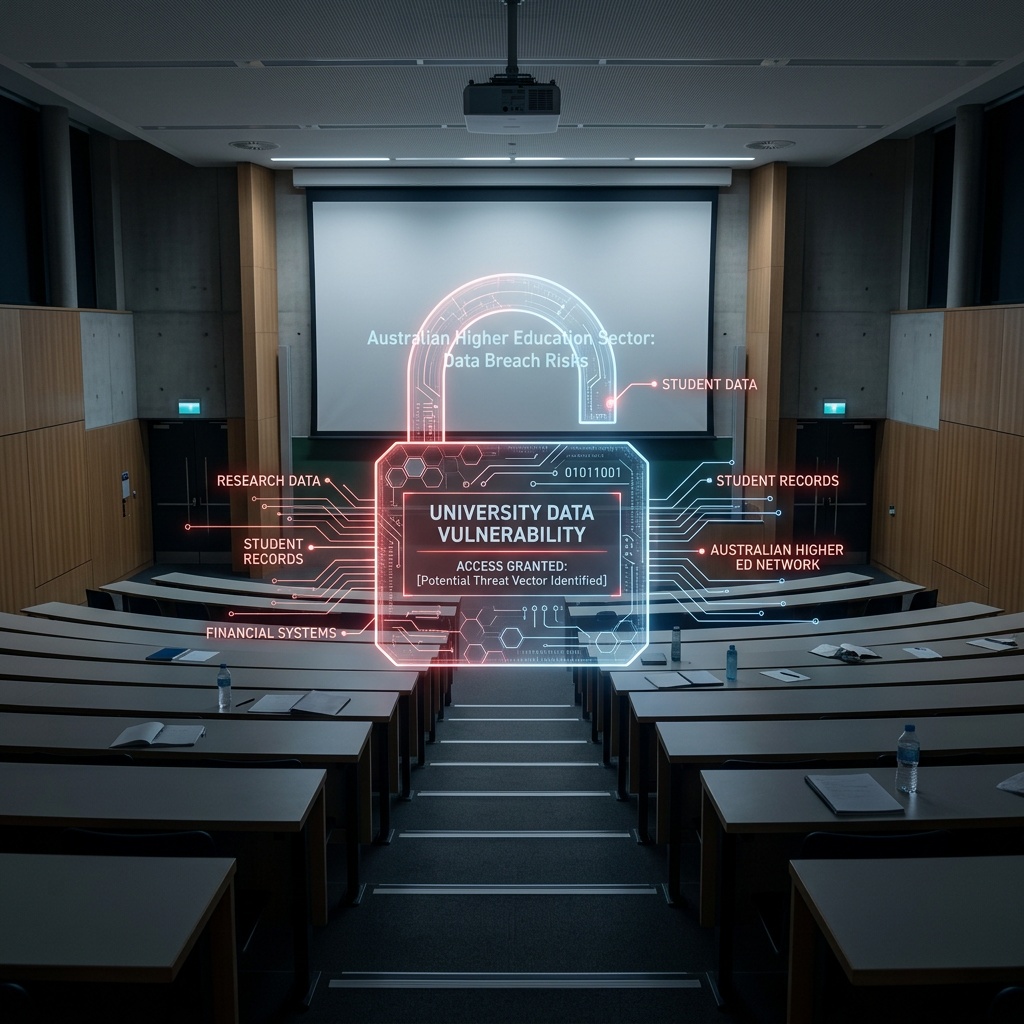
The University of Sydney confirmed in December 2025 that hackers had stolen personal data of more than 13,000 staff, donors, and alumni. Western Sydney University has been breached four separate times in the last 18 months, exposing passports, tax file numbers, payroll data, and health records. Loyola College, Belmont Christian College, Scotch College, Waverley Christian College, Mount Lilydale Mercy, and the Victorian Department of Education have all been hit. The university data breach problem in Australia is no longer an isolated crisis. It is a systemic failure that reaches from preschools to postdoctoral research centres. If you run, govern, or supply any education provider in Australia, the threat landscape has changed and your security posture probably has not.

The Scale of the Australian University Data Breach Crisis
Education was the number four most-reported sector for notifiable data breaches in Australia in 2025, and the trajectory is upward. The pattern in university data breach incidents includes:
- Extended attacker dwell times of three to six months
- Theft of tax file numbers, passport scans, and payroll data
- Compromise of both staff and student records
- Exploitation of third-party student management systems
- Phishing attacks launched from legitimately compromised staff accounts
The January 2026 Victorian Department of Education breach alone affected all 1,700 government schools and exposed current and former student data.
Why Attackers Love Education Targets
Universities and schools combine the worst of all worlds from a security perspective:
- Massive, distributed user populations with thousands of staff and tens of thousands of students
- Legacy IT environments with systems dating back decades
- Decentralised governance where each faculty or campus runs its own tools
- Open research culture that resists access restrictions
- Huge volumes of sensitive data including financial aid records, health services data, and research IP
The Western Sydney University Case Study
Western Sydney University has become Australia’s textbook example of what not to do. Breaches in January 2024, August 2024, April 2025, and October 2025 exposed a cycle of compromise, incomplete remediation, and recurrence. Hackers accessed cloud-hosted student management systems via third- and fourth-party providers, exfiltrating:
- Tax file numbers and passport details
- Payroll and banking information
- Health information from student services
- Enrolment and demographic data
The lesson is brutal. A single breach that is not fully remediated almost always leads to another.
Recommended Link: Security Awareness Training for Schools and Universities
Six Controls Every Australian Education Provider Needs
- Enforce phishing-resistant MFA for staff and students. No exceptions.
- Segment networks. Student Wi-Fi, staff systems, research networks, and admin systems must be separated.
- Patch continuously. Most education breaches exploit known vulnerabilities that were already fixable.
- Deploy EDR across all endpoints. Antivirus alone is insufficient.
- Back up student management systems offline. Ransomware specifically targets these.
- Manage your third-party platforms. Your student system vendor is your risk.
Recommended Link: Monitoring and Maintenance for Australian Organisations
Is Your Campus One Phishing Email From the Next Headline?
The university data breach crisis is not slowing. Attackers are specifically targeting education. Act now, before your institution joins the list.
- Assess your current cyber maturity against the Essential Eight
- Review your third-party student system risk exposure
Frequently Asked Questions
Q: My school is small. Are we really a target for a university data breach style attack?
A: Yes. Belmont Christian College, Loyola College, Scotch College, and many others were specifically targeted in 2025. Attackers target schools for student data, parent financial details, and donation records.
Q: Aren’t our student records protected by law already?
A: Legal protection does not equal technical protection. The Privacy Act creates obligations but does not stop attackers. Technical controls plus compliance is the only workable approach.
Q: What is the single biggest contributor to education sector breaches?
A: Compromised staff credentials used for phishing or direct system access. MFA combined with security awareness training addresses most of these incidents.
The university data breach crisis in Australia will keep making headlines through 2026 and beyond. The attackers have found a sector with high-value data and weak defences, and they are not slowing down. Every board, every vice-chancellor, every principal, and every IT leader in Australian education needs to decide whether their institution will be proactive or just the next headline.
(We are not looking to replace your current provider, just offering an alternative perspective)
Written by Neil Frick
Sources & References
- Cyber Daily – Sydney University hacked, over 13,000 impacted – https://www.cyberdaily.au/security/13040-sydney-university-hacked-over-13-000-impacted
- News.com.au – Western Sydney University cyber breach – https://www.news.com.au/technology/online/hacking/tax-file-numbers-and-health-information-western-sydney-university-suffers-major-cyber-breach/news-story/faa2779f1e42b7454e850f8bb92cc939
- Cyber News Centre – Victorian schools hit by major data breach – https://www.cybernewscentre.com/15th-january-2026-cyber-update-victorian-schools-hit-by-major-data-breach/